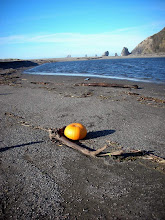
30 October 2007

Told ya it wouldn't take another 86 years!

Essentially wire to wire, this moment was inevitable as far back as mid-May.


It's not the angst-filled Sox of yesteryear. We're not waiting for the inevitable catastrophe to add another chapter to the lore of losing gloriously. It's page 2 of a new chapter of dominance. Some may worry that the Sox will become the Yankees, the new team to hate, but I'll enjoy this ride while it lasts. And with the young guys - Papelbon, Pedroia, Ellsbury, Beckett - they'll be back.

Hot diggity dog...what a great run!

28 October 2007

Indian Summer

23 October 2007, Tuesday, around 930am (though not transcribed here 'til Sunday 28Oct):

After a week of October rain - at least 7 or 8 inches worth - an Indian summer rambled on to the north coast. The rain (and a bit of work) had kept me off the beach most of the week, but following a day when the sun glared down and temps reached a near unheard of 80 degrees...on the beach!...I had to get out for a while.

Unlike yesterday though, the morning was cool. A steady, soft breeze came in from then north, over the tops of the waves. The sky cloudless and glowing bright blue.

I wandered to the creek's mouth from the south end of the estuary. A flock of maybe 40 Canada geese honked a noisy escape when I approached, leaving behind only a smattering of dark duck-like water birds that I couldn't identify cuz of sun glaring off the placid backwater.

Even from this distance, I can see the mouth of the creek has widened since last week. Pacific waves roll through the gape deep into the estuary. The narrow 50-foot channel that opened just a week ago is now closer to 50 yards across. The sand bar has been obliterated, the shoreline now a steep 4-foot cliff, eroding gradually between each push and pull of ocean and river. A half dozen harbor seals and a couple of gulls coast in the roiling waters between ocean and river.


The water at this junction of Pacific and Redwood Creek runs in every direction. There is constant noise standing here at the edge. The crashing surf is almost drowned out by the whooshing sounds of river pushing its way forward. The flush of the main creek channel is clearly visible, a steady boulevard of blue water parting the undulating white run-up of the sea.

There is an amazing amount of water here. That has to sound fairly inane as I stand on the edge of the world's biggest ocean, but you feel the power of the water, indeed of the earth standing in a spot such as this. Not a quiet spot where nothing happens - except in an egocentric human life perspective - but an ever-living, moving, and changing, transmogrifying eternal place. I'm reminded of a sappy line in a Disney Pocahontas song, something about how a foot never enters the same river twice.


A sudden shift in the breeze raises the temperature noticeably. Now from the west, from over the hills, it warms quickly. (We'll eventually get back to the mid-70s later in the day.)

I turn my attention away from the creek to the silver beach and surf. Seagulls sit atop the waves, lifting briefly as the waves crest and break, or floating up and over the curving tops before the crash. There is a lot of organic material - brown leaves, twigs, small branches - in the surf today, coloring the green-blue of the waves.


We still have pelicans, though most only visible through the binoculars, feeding maybe a half-mile off-shore. Now and then, small clusters of pelicans soar by, surfing the tops of the waves. Western and California gulls plod in the sand nearby, but none of the gray Heerman's gulls.

Hasta la proxima.

26 October 2007

Was there ever any doubt?

Certainly wasn't in our house. Well, except for Mrs Glass-is-half-empty moanin' through a mostly tense game, "They're gonna blow it. Here it comes. I can't watch this anymore."


For me, when everyone else was moanin' 'bout being down 3 games to 1, and how the Sox were one game away from going home, I was yakkin' to any who would listen (and there aren't that many out here who give a rat's ass) that the Injuns were just 3 games from their inevitable elimination.

Bring on the Rocks and the snow. Been my contention for a while that anyone the NL puts through this season is gonna lose to anyone in the AL. The Injuns provided the Sox with a worthy Championship series. The Rockies are simply the post-game mop-up work that must be done before the flag is hung on the Fenway flagpole.

This pose was my pose (and I sup-pose a host of others in the extended Red Sox nation) about 9:12 pm last night:

Chasing Chewbacca with Chickens (free-range of course)


Seems the hunt for Bigfoot (or Sasquatch or Yeti or Omeh) is heating up on California's north coast. Led, or at least chronicled, by a former Humboldt County politics and society blogger known as "Captain Buhne", the search leads into directly into our neighborhood's "Haunted Forest", otherwise known as Redwood National Park.

Curious? Check out the tabloid-ish cover story from this week's North Coast Journal, "Bigfoot Trapped by Norcal Fanatic".

Now perhaps I'm too much a skeptic. I have spent a summer reading about science, reason and faith courtesy of Sam Harris, Christopher Hitchens, and Unitarian preachers after all. Hundreds, possibly thousands of secretive, breeding primates wandering the backhills of America's most road-strewn national park? You'd be better stashin' your faith in a world-savin' Jew borne of a teen virgin and an elderly carpenter. Oh yeah, guess that one's still floatin' out there too.

So our good Captain Buhne sets off to prove Bigfoot's existence by concocting several thousand words documenting the complete lack of evidence for any such beast. Short of any convincing documentation via the scientific record, the Captain baits the redwood forest with Bigfoot's favorite cuisine: whole free-range chickens bungied to tree trunks. Why the mysterious creature would turn his nose at a chicken from one of our national industrial chicken factories isn't explained. (Perhaps Sasquatch read The Omnivore's Dilemma, previously reviewed on these very pages.) Finally, we're treated to the Captain's determination to wait the requisite 10 days for a legal firearm to embark on an illegal hunt with a national park to "bag" a Bigfoot of his own, the fame and fortune of great scientific discovery revealed finally to an appreciative world.

Let's take a look at the Captain's thought processes, shall we?

A long time ago, a couple of Humboldt cowboys curiously carrying a movie camera while riding in the remote forests captured a few seconds of iconic footage of a hairy and large-tittied Sasquatchette, who now goes by the classic 60s name of Patty. (Why doesn't anyone name their kid Patty anymore?) Though no one else has ever produced any footage of similar Patty Bigfoots, or Patrick Bigfoots for that matter, it doesn't seem to bother Captain Buhne or the true believers. It's enough that the photographer died without admitting to the lie, and that his trusty sidekick hasn't coughed up a better explanation in all these intervening years. Captain, the lack of a deathbed confession isn't proof that it happened.

The Captain relates his own close encounter in Redwood National Park's "haunted forest" three years prior. While wandering back to his vehicle in the shadowy mists, he heard three knocks on the trees followed by another set of three knocks. Suddenly. a shower of "golf-ball sized stones" rained down upon our valiant seeker. Knock three times roughly translates as "Ready. Aim. Fire" in Yeti it seems. (Or was Tony Orlando fuckin' with the Captain's mind?) The Captain claims to know that it wasn't woodpeckers tossin' stones at his head since there's no proof that woodpeckers can actually throw things. Apparently he's never seen the Woody Woodpecker Show. Giant blue woodpeckers with white gloved hands haven't been positively documented in the redwooods either, but that doesn't mean they don't exist, does it?

Captain Buhne tries to breathe a little science into the discussion. "Academics...posit that Bigfoot is likely Gigantopithecus blacki", an ancient precursor to modern orangutans. While the Captain would like us to believe that G.blackis wandered over the Bering land bridge 12,000 years ago alongside our own first Americans, scientists have already shown that the G.blackis disappeared from the evolutionary record more than 100,000 years ago and no sign of 'em has ever been found in North America.

Those damn inconvenient facts. No problem for the believers though, because there are several mysterious plane crashes in the northwestern forests that prove that you'll never find remains of Bigfoot either. (Huh?) Yes, according to the captain, the lack of evidence confounded by irrelevant analogies= proof.

Want more? To prove that the redwood forests support enough food for a population of thousands of wandering Bigfeet, Captain Buhne notes the enormous populations of Roosevelt Elk. That elk can find food enough proves there's plenty for the Sasquatch family. If there's enough grass for the elk, then there must be enough chicken for the Wookie goes the logic.

Let's end this with the Captain's attempt to photograph Redwood National Park's Bigfeet through hidden cameras and not-so-hidden chickens.

"I strapped several cheesecloth pouches of raw chicken to nearby trees, fastening the juicy bundles to trunks in view of the game camera such that, arms outstretched, the baits are positioned well above my own 6-foot, 3-inch head. (The oozing pockets of free-range, organic poultry would sit out-of-reach of every known forest inhabitant, I calculated.)"

Raw chicken, oh so carefully placed out of reach of every known forest inhabitant? Apparently our Captain's never heard of black bears, known to climb high into the redwood trees in search of the sugars and bugs hidden under redwood bark or the carelessly hung food sacks of unwary campers. Nor does he know the qualities of ravens who scour the forests for anything edible. Racoons? Must not have 'em here.

But yet, the Captain's camera did snap photos of black bears and foxes drawn to the smell of the hanging free-range snacks. But suddenly, or somewhere in the span of three hours when the camera apparently didn't take any photos at all, the chicken vanished. Something had taken it while the camera rested. Not the bears in the photos most certainly, but a critter with opposable thumbs! Captain Buhne's camera did spy a black-hair covered shoulder. Bigfoot? Bear? Skinnydippin' Greek camper? There's your proof of the existence of Bigfoot in the redwoods.

Thanks for all your efforts Captain Buhne. And good luck on the hunt. We eagerly await your follow-up report.
--- --- ---
Ya know. I generally trust the North Coast Journal more than I don't. The tabloid cover and the impossible story so close to Halloween imply to me a good Halloween ghost story. A Sidd Finch tale for Humboldt County.

Ya almost had me there, Captain Buhne. I'll give you a call you if Tony Orlando starts banging on trees next time I'm hikin' the Lady Bird Johnson trail.

Winter comes to the north coast

Monday 17October2007, around 930am...

It's been more than three weeks since I've taken the short walk down the beach to the mouth of Redwood Creek. (And precisely one month since I've chronicled it here.) Three weeks of bullshit government bureaucracy, cranky weather, short days caused by my post-work p.m. schedule, and general early fall sloth. But today I took the time seein' as how the visitors were few and we had a little extra help at the Visitor Center with the surprise arrival of one of our volunteers.

9:30 marks the morning's low tide. The slope to the surf is steep, the edges of the last high tide etched in a fresh line of waterlogged driftwood. The first real storm of the season came last Wednesday in a 2.5" soaker. Scattered showers over the weekend added more wet to the coast along with a good downpour early this morning. But now there's a nice break in the showers, a slight cool breeze from the south, and even a few patches of blue highlighting the varying shades of gray blanketing the sky.

A flock of maybe 60 Canada geese in an enormous V fly high overhead. Two smaller Vs of six and seven geese each fly inside the larger formation. There are just a few honkers in the group making me wonder if there are designated talkers in a flock of flying geese, those shouting out directions or encouraging the stragglers, or if they are simply the chatty Cathys of the bunch.

Walking north in the wet sands near water's edge, the sound of fall's stormy surf captures my attention. Visually, the waves are higher than they've been in the past couple of weeks, maybe eight to ten foot swells cresting and running to the shore in 10 second increments. But what I've not really noticed before is that it's the retreating waves dominating the soundscape. Close your eyes, as I do now, and you hear the upward trilling of the wave as it slides up and back down the coarse sands. The low drumming of the cresting waves further out are the background bass to the more lyrical run-up and back-down of each wave.

As the retreating waves slide back to the sea, they provide a smooth floor for the next wave to roll up the slope. There's a visual tension between advancing and retreating forces that slows and controls both their progress. Where the sandy slope angles to one side or the other, the diagonally backing waters force a spouting line of white foam in the full length of the incoming wave.

Approaching the mouth, the familiar flock of gulls and pelicans rest at the apex of the waveslope. They're not doing much of anything. A few sit. A few stand. And a few wander between the crowds. The pelicans bail out as I approach, the dozen or so of them bouncing three times in the sand as they build up wing speed enough to lift their bulbous bodies up and over the waves to nearby sea stacks.

There are more immature gulls out here than a few weeks ago. Dark brown and mottled, one with a nearly black head, another with dark rings around his eyes (a teen who stayed out too late perhaps?). They are western gulls, just young ones without the distinctive, clean white and gray markings of their elders.

The mouth of the creek is indeed open now. I'd been told it opened after last Wednesday's two-an-a-half inches of rain, but now I can tell y'all that I've been there and seen it for myself. I've always loved this point of clashing contact between river and ocean. The steady push of creek water is easily traced all the way into the crashing waves. The pulse of each ocean wave forces sea water over the rushing fresh water into the estuary behind the sand. In between, swirling eddies and ragged waves decorate this meeting of two worlds.

A western gull perches on a dark rock in the middle of the two watery worlds. Throughout the hour I spend in and around here, he (she?) doesn't leave, standing as a sentry on his small-scale Rock of Gibraltar.

Three seals slide in and out of this middle ground, surfing outward with the river's surge into the Pacific, and swimming back to the estuary in the calm eight foot- deep channel underneath the roiling swells.

This is my favorite corner of the beach, and love to be down as close to this joining of fresh and salt water as common sense and dry sand allow. The hazards of this spot are brought back to me suddenly when I hear water rushing in around the corner of the elevated sandspit to where I stand, my back momentarily to the ocean, eyes staring at the estuary. The water swells in the narrow channel as I scamper quickly to a higher spot of sand. My footprints are quickly erased from the wet sand, before the wave is spent and the water returns to its narrow channel. While never in any real danger of embarking on my own watery journey this time, I'm reminded that this transition zone is best left to loftable gulls and slippery seals, not slow-footed, Gore-tex booted rangers in heavy green jeans.

The estuary behind the sand spit is quiet and calm save for the occasional pulse of water from the overriding sea. The opening of its path to the Pacific has drained the estuary and its shores are perhaps 15 feet lower than they were last month. The south estuary that wrapped in behind the levee'd walls of the creek's mainstem is dry now. A flock of gulls bathe in the freshwater, furiously flapping their wings splashing water high above their heads, rocking side to side, and dipping their heads in and out of the water's surface.

A solitary egret, white and tall, stands in the rocks along the levee's edge, still, unmoving, waiting.

One pelican floats quietly, a few yards north of the splashing gulls. Just watching.

I wander up the backside of the sandspit through the piles of driftwood and back to the surf. It's just over an hour since I started this morning's saunter, but the wave heights have increased dramatically. Another storm is anticipated tonight or tomorrow that will swell the waves upwards to 15 to 20 feet high. My footprints from an hour ago are gone as the rising tide eliminates all evidence of this morning's walk.

Gray skies still dominate though small patches of blue appear between the grays allowing quick flashes of sun to hit the beach. The breeze has definitely picked up a tad.

A most glorious morning.

"The Omnivore's Dilemma", by Michael Pollan

It's not often a book comes along to change the way you think and act. I'm guessing most of us read books that support perspectives we've developed already. I've read a ton of great books lately, and many of them offer new insights and different twists. But books that truly open the eyes, at least for me, are rare. Tom Hodgkinson's book, How to be Idle, was the last book to provide me an entirely new way of seeing the world. Christopher Hitchens' God is Not Great, which I read earlier this year, comes close as well, but it probably served more as reinforcement than a real awakening.

The Omnivore's Dilemma is one of those big picture, eye-opening books. Journalist Michael Pollan expertly weaves his way through the morass of industrial agriculture, box-store organics which appear on the surface to offer a better way to eat, and into the world of local organics, before detailing his own journey into a personally hunted and gathered meal. I found the entire book fascinating.

Did you know that more than 60% of all the industrially-created and processed food we eat comes from corn? From the corn-fed beeves and chickens to purt near all our processed food, (including nearly the entire McDonald's menu), our glut of cheap, government-subsidized corn has become the hidden foundation of every American's diet. And thanks to these corn-based diets, we have a surplus of obesity (consider those beautifully marbled ribeyes and the chicken's artificially large American breasts), diabetes, and heart attacks, not to mention polluted rivers and farmlands, farmers on welfare, and wars for oil.

Do you realize the environmental costs of the burgeoning organic foods now so readily available in our "whole food" supermarket chains and in the neighborhood Safeway? When measured in transportation and packaging costs (read petrochemical costs), the impacts are very nearly the same as foods grown in the industrial food chain. Sure, they'll be slightly better for you healthwise, but the costs to the planet are just as high.

I had hoped for this kind of measured expose when I read Fast Food Nation a few years ago (though it didn't effectively get me to kick the fast food habit). Pollan has convinced me of the value - both to my own health and that of the planet - of eating foods made, grown, and created locally. Since beginning this book, I've made more trips to the local farmer's market and scanned the cards at the local co-op more diligently to see where my food is coming from. I'm convinced now that it matters. I'm trying to limit the Safeway & Costco visits to toilet paper, toothpaste, and Cheezits. Now I'm considering how to put together my Thanksgiving meal with all local foodstuffs. Go ahead...add a challenge to a full day's cooking!

Now I'll not step out and say I'm a full-blown convert and become entirely local and organic. I know I'll still drive-thru for the occasional double cheeseburger value meal. And I'm not gonna quiz the waiter at the local eatery on what the chicken ate before I ate the chicken. It's all in perspective. But Pollan has convinced me that our food's provenance matters. If we are what we eat, we should try to know a little something about where what we eat came from. That shouldn't be so hard.

Anyone up for some Brio sourdough with Humboldt Creamery butter alongside the Willow Creek Farms cherry tomatoes and Cypress Grove Chevre?

So little time

Seems I have two wildly busy seasons anymore, with a whole lot of generic, though generally manageable, busy-ness the rest of the time. May is one of those periods: coaching two girls softball teams with games every night of the week, while coordinating the scheduling for the whole league, and at work I'm hiring and training our new summer rangers and shepherding in another busy summer season.

That other crazed season is right now. Though visitation is down at the park - October 15th usually marks the day that our numbers fall off the table - and winter's rain started in earnest late last week, our staffing is also down with the departure of the last summer ranger. Our winter ranger's hiring has been stalled due to bureaucratic foot shooting which, as of October the first, requires all new hires to clear a background check before they step behind the desk, a process that could take up to a month After all, we wouldn't want al quaeda operatives staffing our quiet visitor centers in the dead of winter. (Actually that wouldn't bother me as long as they don't call in sick on weekends and can properly count out the cash register at the end of the day.) For me, it's means more time hanging out at the VC than in my office (not always a bad thing) and trying to sensitively juggle the lonely desk time of the other permanent rangers here.

October is a two sport season for me as well. I'm in the last month of the soccer season with my under-10 traveling team, and just beginning practices for the middle school basketball team. Now, instead of sneaking out of work twice a week for soccer, I'm stealing away at 2:30 or 3:00 every day for one or the other team, whilst trying to keep up a respectable presence at work so I don't piss off the bosses or my coworkin' friends.

Speaking of soccer, our girls beat the league powerhouse yesterday 4-3. Yes, the team that went 0-9 last year with a goal differential around 7, the very same team that had gone 1-6-2 so far this season, knocked off a team that hasn't lost a game in two years. We found ourselves down 1-0 barely a minute into the game as our cross-bay rivals stormed our goal before our kids even realized they'd kicked off. It was 2-0 maybe 3 minutes later when our fullback tipped the ball into her own goal in an shotblocking attempt. And then suddenly it was 3-0 off a penalty kick forced by our other fullback raising a hand to block a shot in the goal box.

But the valiant Thunder eight charged back scoring on a penalty shot of their own just before the half. Beautiful passing and timely runs knotted the score at 3 a few minutes into the second half. Then, with 10 minutes remaining, a mid-field kick, intended as a pass but which became a shot, rolled painfully slowly under and past their falling keeper, its forward momentum sapped mere inches across the goal line for the game winner. The last 10 minutes were a flurry of runs and charges and shots as our opponents pulled out everything to avert their loss. Several great saves by our own keeper and a few direct kicks off the chests and faces of our own girls closed out the game...a most satisfying victory for these beautiful little 9 year old girls (not to mention their long-suffering coaches and parents). I should mention they were almost as thrilled by the homemade caramel apples post-game as they were by the win.

Ah, but back to the time crunch. On top of girls' sports and work, the baseball playoffs keep my ass firmly settled in the family room chair when I'm not on a field or in the VC. The Rockies have forgotten how to lose. And the Red Sox figured out a clever way to lose game 2 of their series. There are more games coming with at least another 3 games in AL, and perhaps only 1 in the NL. Then there's the World Series. And me and the Mrs still have to watch the last two episodes of the first season of 24!

I haven't been to the mouth of my creek in maybe three weeks. The rain, the trip to Arizona, work, meetings, annual stats, performance reviews, basketball, soccer, life, kids, dentists, have all conspired against me. Winter is here. We had two-and-a-half inches of rain last Wednesday so by Friday the mouth of the creek had burst open to the sea. More rain last night with a forecast of continuous wet through the end of this week. Perhaps this afternoon I can sneak out between showers to check things out. Perhaps, instead of writing this pointless screed I could've been walking out there by now.

Findin' a candidate

I'm three weeks shy of four and half decades now and been politically aware and occasionally active (at least in presidential election years) since my mom took a 9 year old me out leafletting for George McGovern in '72. Yet since my first presidential vote - Jimmy Carter in '80 on the day before my 18th birthday no less, I've never contributed actual money to a candidate. Sure, I've donated plenty of time to candidates...at the DC headquarters and New Hampshire for Gary Hart in '84, and in local phone booths, envelope stuffing, and voter turnout stuff for all the Dems from '88 through '04. But I've never handed over any pocket change until now.

That streak ended tonight when I sent along a small sum to the guy from New Mexico, Governor-Ambassador-Secretary-Congressma
n Bill Richardson. Unless the Nobel Peace Prize coaxes Al Gore into the race, Bill's my guy through the primaries.

(Note: What follows is a slightly revised screed posted in an earlier blog incarnation on another site.)

They say all politics is local. No where did I find this more true than when living more than a dozen years in New Mexico. In a state of not quite two million people - a third of them in Albuquerque - opportunities for meeting and even having a meaningful conversation with significant political folks were plentiful.

At the one politically connected hotel in our little town or at rallies by the red, white and blue rocket slide astride the Pecos River, I met both of our US senators (Bingaman and the dottering Domenici), two governors, and buffet tables full of state incumbents and candidates. And I actually had a brief conversation with then-congressman (though not from our district) Bill Richardson. In his standard rumpled sport coat, sans tie, he said talked briefly with me and my daughter...a cool moment for me, but absolutely lost on a three year old. Those were years when I felt that the common folk - like me - might actually have the opportunity to influence the political life of the nation.

Then I moved to California and I lost that personal touch with our national politics. Tucked away in a distant corner of a monstrously huge state, far from the seats of power and money, we are neglected here by anyone of national interest or importance. No one wants or needs to come by this corner of California, including our own US senators and our cartoon-character governor. It's easy to become cynical about the state of national politics when you're so far away from the conversation. And the local politics of fast food regulation, flouride paranoia and agricultural zoning, though essential for maintaining the loopy and free-form character of our neighborhood, seem petty when people are dying by the thousands in wars of choice led by liars and thieves.

So, I'm supporting Bill Richardson this time 'round. He's the only viable candidate with a brave stance on ending the war in Iraq. He has experience in bringing disparate people together, be they dictators and democrats (small d) or Republicans and Democrats (big D). He's got the resume in congress, the state house, the UN, and the cabinet to see the picture from so many sides.

And, because I once shook his hand. Because he came to my little town and took a few moments to talk to me one afternoon and ask me what I did for a living, and what I thought was the most important issue he should be thinking about. Because he asked my daughter's name and flashed a smile and a hello to her.

Yes, he's a politician, and we could rightly question the sincerity of it all. He didn't invite me to join his party of local fat cat fund raisers. He was then the big fish in the small pond that is a small state. He would not remember our conversation, nor would I harbor any fantasies that he would.

In many ways I'm supporting an ideal by supporting Richardson. For me, for now, he represents the ability of real live Americans to touch those who want to lead us. His wrinkled sports coat, casual demeanor, simple and plain conversation reveal the possibility that our leaders might want to come to our little towns and meet inconsequential people like you and me (and I mean that in the kindest way), and they'll ask how we're doing and what matters to us....and that they'll genuinely care about our answers.

Of course, campaign teams work hard to make us believe their cleverly crafted photo ops are really the candidates reaching out to the little guys. They want you to think that Hillary Clinton really is on a listening tour. they think we'll fall for the joke that Bush is pondering a new way forward in Iraq, that Giuliani has courage, that Thompson is awake, or John Edwards would just as soon work in the mill as be our next president.

I know it's all a bunch of ad company driven hooey colorized by nameless news anchors from empty suited media corporations who have bankrupted their news departments, pantsed their journalists, and are driven by money, not a journalistic fervor for truth, justice and the American way.

But for a brief moment nine or ten years ago, someone who mattered in the higher echelon of national politics, seemed to think my daughter and I mattered to him. That's the ethos of politics we must have again. We need the casually dressed, rumple suited real guy who knows how to work with normal people, not just how to work a room of corporate donors. That's the sort of representative democracy I think this country was founded upon. And I'm bettin' a few bucks that Bill Richardson is the guy who can bring us closest to that silly little dream of mine.

Saying goodbye

Here are my grandfather's rules for living to 100:
1) Take a nap every day.
2) Bourbon at 5:00.
3) Don't eat your vegetables. (Unless they're covered in sauce.)

My fathers' father turned 100 years old last December. We celebrated the centennial that none of us ever doubted alongside his three children and their spouses (and including my divorced mom and her second husband), his then grandchildren (plus nine spouses), and his 22 great-grandchildren. A party complete with a catered outdoor meal and fireworks that lit up mid-winter suburban Phoenix skies where he's spent his last 25 years. A wonderful tribute for a proud and honorable man who despite a remarkable career in business, a life of aviation, world travel, and philanthropy, views his family, from top to bottom, as his lone success.

This past summer, my 100 year old grandfather fell getting out of his car at his summer cottage near Cape Cod. He fractured his pelvis, not badly, but enough to put the family scion into a full-time day care facility for a few weeks and limiting his movement upon returning home to Arizona. It seems that this last injury finally made my grandfather feel his age.

And thus began, at least outwardly, his slow, graceful walk into the proverbial sunset. Unable to get around as he wished, relying on the supporting arms of his oldest daughter and oldest granddaughter, my grandfather's body is at last winding down.

I suppose 100 years is a lot to ask of any body. We all know this, but then again we also knew that nothing would stand in my grandfather's way of reaching his centennial. But now, the next milestone - 200 years - is too much to ask of himself.

I spent three and half days last week visiting my grandfather for what I fully know is the last time. He still retains all his mental acuity - his sense of humor, of politics, of books, of family. He knew me through the haze of his tiring eyes. He asked after my wife and his two great-granddaughters by name. He asked about our jobs, remembering my wife had recently been promoted. He wanted to know if he should send John McCain the money McCain's asking for. (I advised against it, though he pshawed my suggestion of writing the check to Obama instead.) He still carries on a good conversation, though after three or four exchanges, he tires and appears to drift off to sleep.

My father and I talked through my grandfather's apparent mid-conversation naps. My dad leaned in once and asked him, "Dad, when your eyes are closed, are you sleeping, or are you still listening?" To which my grandfather grinned, raised his head, opened his eyes and said, "I've heard every word you've said. It's just not very interesting."

My grandfather's body is simply giving out. It's his heart mostly. The blood isn't pumping well. He's always tired. Any amount of exertion, simply walking to the bathroom or cutting the meat at dinner, tires him. He's not in pain. There is no cancerous rock in his belly slowly and painfully overtaking his organs. He's just tired. And this, I see as a fitting way for him to let go.

You feel his quiet pride when you're with him. And you feel the frustrations of this proud and honorable man, so used to doing things for himself, as he gradually allows others to take control of his life. He doesn't like being cared for, or fussed over, or managed. (He wouldn't let me adjust the bourbon and soda I made him that he said was a bit too strong.) He didn't give in to the notion of 24 hour caregivers until last month. No longer able to control his own bowels and requiring help in cleaning himself up, he simply announced to my aunt and cousin that he didn't want his "nearest and dearest" wiping his ass. The caregivers arrived the next morning.

Now my aunt, my cousin, and the caregivers are in charge of his heart, his breathing, his medications, his bowels, and his food. At some point, when the quality of life is not there for him, he and his doctor will make a decision to discontinue that kind of management. But for now, he delights in family visits and happy hour guests, even when nothing is said. And my visit last week was but one in a parade of family and friends.

He's never spoken much of his faith or what will happen after. One of the night nurses told us that my grandfather woke up in the middle of the night and sat on the edge of the bed talking to himself. He spoke to Martha, his mother, and Edie, his wife (my grandmother). In his apparent sleep, he was asking them if they're going to be there when he arrives, and telling them that he can't wait to see them again.

But when asked by the hospice nurse if he wanted the chaplain to come by just as someone else to talk to, my grandfather emphatically said, "No. I don't want him here." He's even refused the visits of his local pastor, the one who buried my grandmother six years ago. He doesn't need their counsel to feel comfortable in what comes next.

Mostly we sat together. We shared lunches and dinners, the vegetables slathered in homemade hollandaise. We talked. I watched him sleep. I helped him keep the oxygen cannula hooked over his ears. We were simply there with him.

As the moment closed in when I had to leave, I stalled going into his bedroom. It was just past noon and he was still sleeping. I found myself moving so slowly, holding back that moment when I would see him for the last time, when that final goodbye was imminent.

A deep breath and I walked in to the bedroom I almost never entered as a child. I sat next to him and he opened his eyes. "Is it time for you to go already?" he asked. (I remember thinking that statement would've been more appropriate coming from my mouth.) I took his hand and told him I loved him. I told him that my daughters loved him too. I couldn't hold back the tears when I uttered the words, "I love you". Hearing the tears and the muffled snorting in my throat, he said, "I love you, too." He closed his eyes again, and I left, quickly, without looking back wanting to spare him the notion that this was a last goodbye, though I know he's experienced a entire month of final goodbyes from so many of us.

He is such a huge part of my life. Such a tremendous presence. I'm glad I made the trip. It would've been easy to use work or coaching or family as an excuse to put off the visit. I would've regretted it. Not much was said between my Dad and I on the way to the airport. Small talk. I just wanted quiet and was happy that air travel today is such crowded anonymity. I felt pensive, not really wanting to speak with anyone or about anything. Just quiet, remembering the moments over the past near 45 years with him, squaring the image of the tiring man in the bed with the enormous presence he's held throughout my life.

My next visit to Arizona will be different. The place will be empty without him. But I'm hoping, as are all my cousins, and aunts and uncles, and brothers and sister, and all our kids, that the moment will be seeded with the thrill and honor of being able to be part of his life, and the pride of knowing that his legacy continues through our stories and memories of him.

My Daughter's Morning

Courtesy of Garrison Keillor's radio broadcast, The Writer's Almanac, here's a poem by David Swanger that spoke to me on my way to work this morning. As the father of two daughters, it's nice to be reminded what we mean to our little girls. I'm many years removed from the diapering days outwardly portrayed here, yet I still witness almost daily the anticipation of escapades in the eyes of our nine year old. The eyes of a 13 year old more often reflect the amazing idiocy of her paternal parent than "the first version of later princes", but the smile and love and admiration are still not too deeply hidden...at least not yet.

For all of you with kids, enjoy....

My Daughter's Morning
by David Swanger


My daughter's morning streams
over me like a gang of butterflies
as I, sour-mouthed and not ready
for the accidents I expect

of my day, greet her early:
her sparkle is as the edge of new
ice on leafed pools, while I
am soggy, tepid; old toast.

Yet I am the first version
of later princes; for all my blear
and bluish jowl I am welcomed
as though the plastic bottle

I hold were a torch and
my robe not balding terry.
For her I bring the day; warm
milk, new diaper, escapades;

she lowers all bridges and
sings to me most beautifully
in her own language while
I fumble with safety pins.

I am not made young
by my daughter's mornings;
I age relentlessly.

Yet I am made to marvel
at the durability of newness
and the beauty of my new one.

Take me out to the ballgame

Katie Casey was baseball mad,
Had the fever and had it bad.
Just to root for the hometown crew
Ev'ry sou, Katie blew.
On a Saturday her young beau
Called to see if she'd like to go
To see a show, but Miss Katie said
"No, I'll tell you what you can do;"

Take me out to the ball game
Take me out to the crowd.
By me some peanuts and Cracker Jack,
I don't care if I never get back.
Let me root, root, root for the home team,
If they don't win it's a shame.
For it's one, two, three strikes you're out
At the old ball game.

Katie Casey saw all the games.
Knew the players by their first names,
Told the umpire he was wrong,
All along, good and strong.
When the score was just two to two,
Katie Casey knew what to do,
Just to cheer up the boys she knew,
She made the gang sing this song:

Take me out to the ball game.
Take me out to the crowd.
Buy me some peanuts and Cracker Jack,
I don't care if I never get back.
Let me root, root, root for the home team.
If they don't win it's a shame.
For it's one, two, three strikes you're out
At the old ball game.

There's no better time of year than the opening of baseball's playoffs, unless of course we're talking 'bout the week that players report to the training camps in Florida and Arizona and the first slap of ball on glove or crack on a wood bat is heard 'round the land. Today's opening day all over again. Eight teams insteand of 30. Five series and whole boatload of games that matter. So it's root, root, root for the home team. The question becomes: Who's my home town team?

The Cubs are in the playoffs for the first time in years. My very first ball games were at Wrigley Field. My mom took me out of 1st and 2nd grade classrooms early a couple of times to watch Ernie Banks, Ron Santo, Don Kessinger, Fergie Jenkins...the fabled 1969 team that collapsed in the final week allowing the Miracle Mets their run at history.

From Chicago, we moved north of Boston for Carlton Fisk's rookie year. Yaz, George Scott, rookies Fred Lynn and Jim Rice, Rico Petrocelli - my all time favorite baseball player name - and El Tiante played the greatest World Series ever against my mom's hometown Big Red Machine - Rose, Foster, Bench, Concepcion - in 1975. That series, along with the 1978 one game playoff disaster with Bucky F'n Dent and the Yankees, cemented my lifelong allegiance to Red Sox nation, and tied me indelibly to the long history of suffering Soxdom. Later, the Mrs and I lived in Boston and could see the lights of Fenway through the apartment windows when Bill Buckner's glove failed us in the 1986 World Series. Though we now have 2004 to crow about, the legacy of inevitable frustration and disaster remain strong.

And yes, these Red Sox hung on to snatch the East Division title from the damn Yankees' 12 year stranglehold on the pennant.

After a short two year stay in Jersey from where I attended my only World Series game (1976 Game 4 Yankees win over Mom's Reds) and my only opening day (1977 Yankees with Catfish Hunter as the free-agent starting pitcher), the family moved over to the Philly 'burbs for my high school years. The Phillies of the late '70s with Steve Carlton, Mike Schmidt, Greg Luzinski and Larry Bowa made their runs at a World Series title, their first coming the year I graduated high school...1980. And this year, thanks to a monumental late-season collapse by them very same Miracle Mets, the Phillies took over first place with 2 days left in the season, and now stand as the NL East Division champs!

So a dream post-season for me. The Phillies. The Cubs. The Sox. I'll be riding with the Sox for my championship dreams, but I've got all three hats in the closet depending on who's playing on any given night. I'm concerned about another Sox-Yankees AL championship series...the Sox have not played well against the MF Yankees the last half of this season, and Manny, Schilling, Wake and Youk all are banged up. Here's hoping the Injuns can take the Yankees out in the first round to clear the Sox' path to the Series.

Go Sox! (or Cubs, or Phils)

Monday morning at the mouth of the creek

17September2007, Monday morning, 8-9am:
Driving across Freshwater Spit this morning, I knew I was gonna have to stop and take a walk before going off to do any real work. It was just before 8am. The sky a glorious shade of blue. The white lines of cresting Pacific waves outlined the silver edges of the beach for miles northward. With the window half down, cool wind in my hair, thoughts of pending projects disappeared. I unlocked the gate, then locked it behind me so I wouldn't have to deal with anyone else for a while. Without even a stop to say hi to our building maintenance lady, I strode out to the beach, binocs, journal and camera in my pockets. Almost immediately, I discovered the dead battery on the camera so y'all will have to put up with poorly described beach scenes of this morning.

It is absolutely clear this morning. A distant bank of clouds lies across the horizon, miles away and well behind Redding Rock. In the east, the rising sun highlights a light haze at the top of the redwood covered hills. A sparkling golden stripe decorates the calm green waters of the estuary.

A few gulls, mostly western gulls, stand and watch the waves and the horizon much as I do. Another small gathering hangs out at the edge of the estuary, while a couple more wander back and forth across the high point of sand, mingling with both groups.

The surf is stunning this early morning. Taller than usual waves, maybe 8 feet high, meet the sand in calm, lazy rolls. During the hour, there are periods of more intense wave activity, maybe four minutes apart, when higher, thicker, and more erratic series of waves loudly announce their arrival. Sudden smacks of water upon water snap me out of moments of quiet meditative calm, reminding me, "Don't get too lost in your own head, son. There's something much bigger here."

Only a single pair of pelicans appear this hour. They slip past up high, then turn back around, perhaps a quarter mile down the beach, returning low over the slipping surf.

A lone seal pops out of the surf, just once, to make sure I'm staying on the beach.

A pair of early morning walkers, at the moment a distant silhouette, remind me that I can't have the beach all to myself. Their pending interruption also reminds me that I have to at least pretend that I'm working. The brain kicks in, "Look busy. They're getting close." So I sit and write in this journal vainly trying to look pensive and intelligent.

It's surprising how muffled the surf sounds are on the creek side of the sand spit.

Two birds of note. In the bushes behind the office and on a few of the taller driftwood branches, a small bird flits back and forth. A black, slightly crested head over a dark gray body. The body is stout. Narrow black beak and long tail. Mr Sibley says it's a black phoebe.

On the ocean, dipping in and out of the waves, fishing on his own, a solitary seabird. Looks enough not like a murre to make me question his/her ID. Reminiscent of a common murre, but lighter brown with white belly. Possibly a pacific loon, but then again, maybe an immature murre. Sounds like a good excuse to come back again tomorrow morning, eh?

Hasta la proxima.

Bird learnin'

12September2007, Wednesday afternoon (though not transcribed from the pen & ink journal 'til Saturday 15Sept07)

I took the back way out towards the mouth of the creek this afternoon, via the southeast corner of the estuary. We're in the middle of what's to become a mostly overcast week: not much fog...just high, gray clouds.


I'm enjoying the self-imposed challenge of trying to figure out the birds of this beach. I'm thinkin' that by taking notes and taking some time and writing this shit down, I might actually remember what the hell they all are for more than 19.5 hours. The problem with my brain is that it generally works in a big picture frame. I see best the landscapes, broad concepts, sweeping history. I don't see as well leaf shapes, temporary flowers, white eyebrows above the eyes, women's haircuts, and daily bureaucratic minutiae. Not a weakness (I've convinced myself), just a recognition of what works with me.


So, when a small shore bird strolls across the opposite shore, my attempt to train myself begins. A small, long-legged shorebird, though not real tiny. My first uneducated thought without the bird book in my pocket is some sort of plover or sandpiper, cuz I know that plover and sandpiper are popular names for shorebirds here. Some of the things I note for later when I do have the book: a white breast and belly, mottled brown wings and back, a narrow and pointed black beak, and, in what I hope will be a couple of defining characteristics - an off-white eyebrow above a distinct black band around the face and double-black ring (below white) under his neck.

You real birders probably already get it, but it took me a few minutes back at the office of wandering through Sibley's guide to narrow it down. It's a killdeer! (A bird I actually once knew way back when, believe it or not.) It's the double black on the chest that gives it away.


As I walk down the back of the estuary, I can only hear the ocean. On the sand horizon created by the high berm of the beach, a line of gulls stand in silhouette. I watch a female gull (or perhaps it's an immature something or other, though I'm probably premature in calling it immature since I really know nothing about this particular bird's character), pick up a 6" driftwood stick, fly up about 25 feet, and deliberately, so it seems, drop it into the middle of the gathered flock. For what purpose, I wonder. A teenage prank? Perhaps he is rather immature after all. A display of jealousy or juvenile manhood? Certainly not nest building. Curious, eh?

One Caspian tern, bright orange beak and black head slips by. I'll see him later, the lone tern in a mass of a hundred gulls.

Where the creek bangs into the ocean's sand spit, it takes a brief left (southward) turn. At the head of the small inland peninsula, eight tiny birds skitter at the shallow water's edge. Smaller than the killdeer, again I think sandpiper or plover. The notes: a light brown head and speckled backs and wings, speckled chest gradually fading into white belly, black tipped tail, long and narrow black beak, and a small patch of white over the eye. There are eight of them in the group, dipping their long beaks into the water...bug shopping I'm sure. They're tiny...I guess 4-5 inches tall at best.

The answer? Semi-palmated plovers most likely. While there could be a couple other good choices, the size seems to indicated the SP plover over the others.

It's just after high tide here. Climbing to the top of the sand spit, only gulls stretch from one end to the other today, plus the aforementioned lone Caspian tern. There are no pelicans gathered on the beach today. Occasionally, a single pelican slips by in the mist, but it's odd they're not here after weeks of huge populations.

A few small clusters of common murres coast off-shore. A smaller bird, mottled underbelly and black above paddles purposefully through the quiet waves. Head raised upward at a slight angle. I guess marbled murrelet, our threatened symbol of the redwood-marine ecosystem. I guessed right, I'm pretty sure, upon consulting Mr Sibly later. Just the one, though.

Three cormorants flash by, wings flapping furiously, on their way south.

I wade into the flock of gulls to see if or how they react. A couple hundred of 'em are in my path, mostly the gray and white western and California gulls with a sizable contingent of Heerman's gulls. The Heerman's are clustered together, a gray patch surrounded by the white-topped rest of 'em. I walk into the crowd slowly. The birds only cautiously stroll away enough to give me room to pass through. Without any herky-jerky motions, they're content to let me move quietly among 'em. It's only when I raise my arm up to pull off my spectacles so's I can use the binocs that they briefly swarm skyward and relocate to new safe positions, again, not too far away.

I think I'm beginning to figger out some of these damn gulls. The Heerman's are surely distinctive...all gray with the bright orange beaks. Not too tough an ID.

We've got your western gulls....tall with a bright yellow, heavy beaks - more bulbous at the tip with a solitary red spot towards the tip of their snout. Their pinkish legs...something I hadn't cued into before, combined with the beak shape seem to help pull the westerns out from the rest of the group. I'm thinking, as I spy through the binocs, that this seems to help in looking at the women and immature gulls too.

Now that I'm deep among them, I'm convinced finally that there are California gulls here as well. (How idiotic this must read to someone who actually knows these things.) Smaller than the westerns, but with similar white heads and bellies over solid gray wings. Brownish, streaked heads, a slimmer beak than the westerns, and with both black and red splotches at the tip of the beak. Pale yellow to white legs help differentiate them from the westerns as well.

Herring gulls should also be in the neighborhood but it's gonna take another trip out here to figger if they're here or not. I suppose I could ask someone who knows, but the discovery is proving fun.

Three pelicans glide down the the surf just inches above the waves. A group of six cormorants accompany them, like the destroyer escorts protecting the battleship. A single seal pops up from the surf, just watching me.

Hasta la proxima.

A tale told by an idiot

Ran across this passage from Shakespeare's Macbeth (which I actually saw at the Globe Theater in Stratford more than 10 years ago). The passage was used in a podcast Unitarian sermon discussing faith versus apathy, with this passage illustrating the depths of apathy, of a life simply existing without meaning or purpose. Suppose I jotted this down cuz there are those days, huh?

"Tomorrow, and tomorrow, and tomorrow,
Creeps in this petty pace from day to day
To the last syllable of recorded time,
And all our yesterdays have lighted fools
The way to dusty death. Out, out, brief candle!
Life's but a walking shadow, a poor player
That struts and frets his hour upon the stage
And then is heard no more: it is a tale
Told by an idiot, full of sound and fury,
Signifying nothing."

How many times does it feel that life's but a walking shadow? Where tomorrow and tomorrow creep their slow, petty pace. The days we spend strutting, then fretting. And in the end, we're heard no more. A life, full of sound and fury that in the end, signifies nothing?

Wow...had not intended to get depressive here, cuz really, life - my life - not without its wallows, is not all that bad. Actually, learning to write all this out seems to help with that.

What really drew me to the passage was the phrase, "a tale told by an idiot". I so wanted to rename this journally bloggy thing after this passage, but it only took a quick googling to realize I'd be one of about 948 online scribblers to do so.

30 minutes for the birds

11September2007, Tuesday, around 430pm
On the beach in front of the Visitor Center, 5 minutes south of the mouth of the creek:


The food's returned to the shoreline after a quiet week, and with it the masses of birds. Not quite as many as last weekend, but this afternoon it's the pelicans and gulls and their winged comrades putting on the display du jour, rather than humpback whales and sea lions. I watched their floating and flying and diving for much of the afternoon, trapped behind large panes of glass and isolated inside the building, unable to leave as I'd encouraged my coworkers to take advantage of the quiet afternoon to get out and about themselves. Not 'til nearly 4:30, did one of 'em return, providing me a brief visit beyond the lip of the waveslope to witness another spectacular marine extravaganza.

Squadrons of awkward, ungainly pelicans flew in haphazard swoops and swirls over a broad swath of of near shoreline. Gliding lazily 30 or 40 feet above the gentle waves, the pelicans appeared to stall in mid-air. Heads downturned, they tumbled from the sky, folding themselves into a tightly tucked position at the last possible moment and, plunging into the chilly Pacific,. They quickly resurfaced into a casual float, their throat pouches wriggling with freshly trapped prey. Through the binoculars, I actually caught the silhouette of a small fish through the transparent pouch of one pelican. They'd float comfortably atop the soft waves for a few minutes before lumbering skyward once again, anticipating the next plunge.


Several times, pairs or trios of Heerman's gulls mobbed the pelicans as they re-emerged from their shallow dives, attempting to jam their own heads into the pelican's mouth to snatch the freshly caught sardine (or anchovy? perch? smelt?). I didn't notice any of the gulls finding success in their poaching, but they were relentless. The pelicans shook their heads and broad pouches side to side and up and down several times to force the gulls away, before tipping their heads back like an American tourist downing tequila shots in Playa del Carmen and swallowing the small fish whole.

A bevy of birds swarmed the ocean this afternoon. A poor naturalist in my own right, I'm trying to figure 'em all out.

A gull with a black tipped beak. Good size. Like a western gull but with a mottled gray head. I looked it up later...first instinct being a herring gull. But on further investigation, perhaps it was an immature western gull? Or maybe an immature California gull? With several phases, a couple different looks to the juveniles, and variations on the variations, separating out the damn gulls is gonna be a challenge.

Plenty of double-breasted cormorants with hooked yellow beaks, float across the ocean's surface. Tucking their long necks into their chests, they dive suddenly, disappearing beneath the surface for a few moments.

Western grebes also float off-shore. Long, white necks, a yellow beak and black cap atop its head. Looked this one up too, and durned if it too might have a close cousin. Did the black cap extend over it's eyes, or not? I hadn't noticed. If the black covers the eyes, its a western grebe. If not, a Clark's grebe. Both are common here. I'll have to look again tomorrow.

Common murres, smaller, mottled brown and sharply pointed beaks float a bit farther out

The pelicans with bright white scalps...mating males perhaps?

Two shiny seals pop in and out of the surf in front of me. We watch each other for a few minutes before they lose interest and wander off.

An osprey glides overhead as we walk to the cars after closing the place up.

When I first ventured out on to the beach this afternoon, all the birds - off-shore and on the beach, moved away. A palpable sense that I'd disturbed the party hung in the air as they skittered or floated off a safe distance from me. I stood on the beach for 10 minutes or so. The birds on or over the ocean returned to their stations shortly. Those on the beach kept their distance.

When I sat down, cross-legged in the sand, with only my binoculars and pen working, the gaps in the sand between me and the birds shrunk 'til I was soon fairly surrounded amidst the flock. But as soon as I stood realizing I couldn't stay here all afternoon, the birds both on sea and land, lifted en masse and returned to the safe haven 50 yards down shore.


Hasta la proxima.

Life off the fast track: A developing strategy for sauntering through work

A while back, perhaps 8 or 10 years ago, I thought I'd discovered the fast track to propel me through a dizzying bureaucracy toward some undetermined higher place where influence, power and salary would confirm upon me a measure of significance. It wasn't so much that I aspired to fame and fortune, but stature, insight and influence.

Like the series of moving walkways in the airport where you hop on and hop off to reach the next terminal quickly, I hopped off the fast track for just a moment, and when I looked back up those fast-tracking walkways had disappeared. An opportunity a year or so ago to jump sideways into a position that might've had me moving forward again, fell apart in a system of bureaucratic burdens and boundaries, and perhaps even personalities and silent agendas. Now that track is gone too, and I'm purt near certain it's long out of sight.

Yet instead of staring wistfully at the horizon, I'm exploring a simpler place - a satisfying and flexible place where I am comfortable simply being who I am. It's a longer term, bigger picture way of seeing my career I hope. No longer am I accelerating forward to something organizationally grander. These days it's more about settling in to a routine that permits me to do what is truly important: being a good dad, a good husband, a good kids' coach, an avid reader and aspiring writer, still earn a satisfactory salary, and, if all aligns properly, contribute in some small way to the experience visitors have in our parks. Influence wielded casually, comfortably, for a few hours a day, and hopefully in harmony with the others around me.

These days my tasks are mostly organizing the efforts of others. I endeavour to keep things running smoothly and ensure that this park is populated with happy, healthy, knowledgeable ranger types to meet, greet, and explore the many wonders of these special places. If I can do that through creating and maintaining an environment that is positive and fun, and we keep the work we do in perspective with our real lives, then I'm quietly satisfied. Perhaps that doesn't look or sound like "work" to some, but that's where my brain puts its energy on the small portion of the day for which I gratefully accept your guv'mint's compensation.

So, herewith follows - far from complete, and a long way from worded well enough to publish as the next great leadership tome stocked in the Staples check-out line next to the ergonomic pink highlighters and laser pointer keychains - a few key work and leadership principles I've developed for myself.

3 or 4 hours of work is a good days' effort. That's generally enough to keep things running and keep you out of trouble. You're reaction to this principle, of course, will depend highly on how you define "work". Real work, for me, is all the daily crap: the meetings, the paperwork, the scheduling, the phone calls and emails, and perhaps some of the heavier-duty thinking and writing and creating that must be done. In my job as a middling middle-level somethingorother, hanging out at a moderately busy Visitor Center talking with a couple hundred people about some glorious places, or walking a redwood trail or a strolling a misty beach, while necessary and part of the job, don't really count as "work"....even though I'm paid to do it. (This feels a lot less true in the crush of summer when we're dealing with a building full of people nearly all day long without time to breathe between questions.) The rest of my 8 hours? Walk around and talk with folks. Keep up with what's going on. Learn. Live.

Treat people like the adults they are. Most of us recognize good work when we do it. We don't need to be told what good work is, or even, in most cases, how to do it. We don't need to be led by the hand through simple steps, or watched over and critiqued constantly. Let 'em know what needs to be done, then stand back and let 'em do it with a minimum of interference. Give 'em opportunities, expectations, and the freedom to solve problems and be creative, and they'll do it well.

Put a minimal organizational system in place and allow it to adjust to the people, not the other way 'round. Avoid tight, inflexible structures that squeeze out opportunities, limit flexibility, and create bottlenecks for conflict. If there's a problem in the system, the folks working within it can usually find the way out better than the boss trying to oversee it from an office down the road.

Good customer service is a helluva lot better than a long list of accomplishments. Ok, perhaps a bit specific to what we do, but in my feeble mind, smiles and thank you's from visitors matter more than numbers and hours and long list of checked-off boxes at the end of a fiscal year.

Creativity beats accountability every time.

Rules are guidelines. More importantly, do what's right...for the visitors and for the park.

Work is what you do, not who you are. A person's life after their 9-5 workin' day is way more important than what they do at the office. Respect your coworkers by respecting their real lives. Don't let work interfere with what matters most to them.

Do only what has to be done to feed the bureaucratic beast. Enter the dark, blood-stained chambers of the monstrous bureaucracy cautiously and only as much as necessary to feed it the numbers, reports, forms, and meeting attendance it requires. It has to be done or the beast will convulse and scream and spit and annoy the livin' bejesus out of everyone. But do it quickly, get it done, and move on with life and the enjoyable stuff.

Keep learning. That's where the fun is. The joy of this profession comes in understanding the world around us. Take - and allow - the time to read, walk, cogitate, chat with others, know, touch and feel these amazing places. Thrilling stories abound. Find 'em and share 'em. (Or keep 'em to yourself and thrill in knowing what others don't.)

This is sounding more like self-serving justification as I write. For now, I'm done. Time for lunch and an afternoon hanging out with the waning September crowds of people and pelicans.

Where nothing happens

Often, I wonder if the places that should be most celebrated, most honored and revered, are those places where nothing happened. Places where life, natural and human, simply is, where life occurs.

I discovered this poem a few months back. Perhaps it holds a thought to take with us on a day when the media and politicians and rabble of all persuasions will overload us with their rendition of the horrible events of 6 years past, and what we've learned - or not - from that day.

Perhaps this is the day to hang my Italian "pace" flag in the office window.

Or maybe I'll take another walk on the lonely stretch of beach where Yurok families once dried fish and carved canoes from massive redwood trunks with the bones of elk, where salmon return from years at sea to mate and die in the same stream in which they were born, where waves finally end their thousand mile journey in the crushing surf and dark sands as they have for eons, and will continue to do so for eons hence.

At the Un-National Monument Along the Canadian Border

by William Stafford

This is the field where the battle did not happen,
Where the unknown soldier did not die.
This is the field where grass joined hands,
Where no monument stands,
And the only heroic thing is the sky.

Birds fly here without any sound,
Unfolding their wings across the open.
No people killed - or were killed - on this ground.
Hallowed by neglect and an air so tame
That people celebrate it by forgetting its name.

Slowing down

07September2007, Friday, 930-1030 or thereabouts

Almost a wintry feel in the air this morning. A cool, steady breeze blows down the beach from the north. The surf is strong, loud and erratic. The waves roll in from many different directions. That's a quality of this beach, and of far northern California that you don't experience on the other side of the continent where I grew up. The beaches of my youth were regular. Waves were predictable. As a kid, I learned the mantra of the 7th wave being stronger than the rest. Even as a kid you could almost prove it scientifically. Not so here.

This morning the surf is a cacophony of movement and sound. Waves of varying heights, densities of foam, and speed, run over, around and through each other, before backtracking down the steep slope into the next incoming surge. The crash of surf is simultaneous with the tinkling backwash. The sea advances and retreats all at the same moment. Irregular. Erratic. Wild. Dangerous. Chaotic.

Far fewer birds patrol the sandspit today. Maybe a hundred gulls and a dozen pelicans. There's a hangover kind of feel in the air, as when a giant party or outdoor festival breaks into its post-frenzy laze. In fact, this past week there was a feeding spectacle off-shore as described earlier in this journal. But today, the dark gray carpet of sand is matted with the three-toed prints of thousands of birds. White shit balls up over the full length of the beach and shores of the estuary. Small clusters of birds congregate lazily like the group of faithful friends who gather in the kitchen to help the host clean the place up, hungover and hungry, but laughingly enduring the trailing headache of the holiday weekend bash.

It's probably not too far a stretch comparing this feeling to that of the remaining rangers at the end of a busy summer. The crushing rush of summer visitors has passed. There are quiet moments again in our visitor centers, time to talk to each other and talk with those who deliberately wait out summer to travel after the visiting hordes have vanished. These shoulder season visitors really are the ones to enjoy. They come here to be here, not just flying through on the way to 19 other destinations in their 9-day minivan road trips with road-weary toddlers and reluctantly-dragged teens. Time to talk and breathe. Kinda nice.

A tightly packed group of five common mergansers paddle purposefully upstream from the back of the estuary. Stiff rust-colored heads, mottled backs, narrow and sharply pointed bills.

An osprey glides over the mergansers towards the creek mouth. I catch him, then follow him in my binoculars. He leads me in a complete 360 degree spin until I'm forced to drop the binocs when the sun through the refracted lens fries my eyeballs.

Nearly an hour is spent sitting, watching, meandering, and quietly contemplating life in general at the mouth of the creek. Several other inspirations, confusions, explanations, desires and ideas end up on the index cards that make up my on-the-spot journal. Some of those brain farts will end up shared here eventually, I'm certain.
I notice suddenly, that not 15 feet from my driftwood bench, a small gull (likely an immature western gull though I debated possible ID's with a coworker much of the afternoon) stands and contemplates the world alongside me. How long has he (or perhaps she) been standing there? We share this patch of beach for another 15 minutes or so. I try to engage him in conversation about the day, life's questions, our plans for the day, the need to return to the real world. But he just stands and listens, absolutely unconcerned about this hairy, windblown, green/gray midlifer sitting on a log scribbling incoherent thoughts and stuffing them into his pockets. Is this little bird brave? Stupid? Injured? Looking for an easy handout like the tattered rag-pantsed bozos on the Plaza?

Perhaps, like me, he's just hanging out, taking a few moments to get away from the others, to recoup, breathe, do a bit of solitary thinking about what's important now that the urgency of schedules and responsibility have eased a bit. It's a good spot the two of us have found. And, I suppose a good spot is a good spot, whether you're gull or guv'mint flunkie.

Walking back to the real world along the back edge of the estuary, a sleek, black cormorant floats in the calm backwaters. He disappears silently into the green water, reappearing a safe, and surprisingly distant 50' feet away.


Hasta la proxima.

Thoughts on time

My watch battery died a couple weeks back. It gave up its silent ticking and tracking of life about the same time I was reading Tom Hodgkinson's book, How To Be Free, a follow-up to my personal bible, Hodgkinson's much better book, How To Be Idle of a couple years back. In both books, TH urges us to lose our watches, to become free of time constraints. A watch is a handcuff to the incessant demands of society, contributes to our sense of busy-ness, responsibility, and duty to an overly organized and ordered life. Freeing the chains of time frees us to think, relax, loaf, saunter, and reflect. Without a time-keeping handcuff bound to our wrist, we can bust out of these bounds and begin living a freer life.

We do, in fact, over-program our lives. I do mine certainly. There's too much to do and not enough time to do it all. Whenever I'm asked what I want for Christmas or a birthday, I ask for more time, knowing full well that's something no one but me can give. There's a time to be at work, for buildings to be opened and closed. The kids have to be at school on time, and they have to be picked up so there's time to get them to ballet, and soccer, and piano lessons at the proper time. Ten families depend on me three times a week to be on a grassy field to organize their kids into a 90 minute soccer practice. I can't be late getting there and they have to leave right at six to get their kids to the next scheduled activity. The expectations and schedules of multitudes of others depend on our strict individual adherence to this man-made construct of monitored time. Seems a shame, don't it?

Over the years I've been both frustrated and awed by the very real concept of "Indian time". At the risk of being hopelessly un-PC and overly stereotypical, if you've worked any length of time with American Indians, as I've had the pleasure of doing, you quickly become familiar with a more flexible attitude towards time. Meetings or gatherings begin when everyone arrives, and people will arrive when it's time. We'll take the time necessary to get it done. Or maybe we won't get it all done this time, but we can find another time to finish it. We'll end the gathering when it's time to end it. There's a lot to be admired in this vision of how the earth and society moves forward. There can be a lot of frustration certainly, if we find ourselves bound to a stricter interpretation of time, but wouldn't a more relaxed accounting of how we get together and make things happen help us enjoy life more fully?

But what are the alternatives to watch wearing? I've found there are certainly plenty of places to keep track of time without strapping myself to a timepiece. The bottom right of this here computer, for instance. The VCR, microwave, and bedside alarm clock. The clocks in our cars, on the banks, on our cell phones, on the wrists of our friends and coworkers. Really, life without a watch is not that difficult.

Now, I'm learning how to run my soccer practice without the aid of a watch. We have the pleasure of a practice field next door to the local catholic church. Soccer practice begins with the 4:30 bells, with warm-up, stretching, and dribbling & ball handling skills running 'til the five deep gongs at the top of the hour. From there 'til the 5:30 chimes, we teach and coach, learning new skills or reviewing old ones. Finally, a scrimmage takes us up to the end of practice with a final whistle blown at the end of the 6th gong. It works. It's become part of the rhythm of our practice, and it's all done without a sweaty leather band that reminding me to check every few minutes to make sure time still marches forward.

And no annoying tan lines either.

I'd write more but I need to get my kid back from a sleepover so we can get her fed, dressed and showered before our 11:30 game, for which I need to be at the field and ready to go promptly at 10:45.

Late afternoon at the mouth of the creek

04September2007, Tuesday, late afternoon (notes from Tuesday, but not transcribed from the handwritten journal 'til this mornin'.)

Another late afternoon opportunity to wander to the mouth of the creek. It's interesting now that I've committed myself to document the happenings here, to become that self-appointed inspector of this small piece of earth, how the opportunities seemingly present themselves where they hadn't before. There's a desire, at least a week old, to be here daily and see what's changed, what's the same, and what's new to discover. It's a few brief moments from my day to reflect and relax, and to share, if anyone cares to read along.

Hazy again this afternoon. A large colony of gulls stands once more astride the narrow sandspit at the creek's head, fewer than in days past however. It appears the great feeding frenzy of the Labor Day weekend is waning. The humpbacks that put on such a great show disappeared about 1pm this afternoon, and haven't been spied since. The pelican population is down too from yesterday's air extravaganza.


Walked clear across the sandspit, through the gathering of gulls and pelicans, to the north side of the beach. A nice view of the birds paddling quietly where the creek dead ends in sand, currently barred by lack of force and mellow ocean currents from emptying to the sea. The north side is the more heavily used side of the beach. A small dirt road provides access for local folks to get to the beach without entering through the park's "official" parking lot and making the 5 minute walk 'cross the sand. In the winter, when the creek runs free to the Pacific, this piece of beach is only accessible via the narrow farm road. While still scenic in macro, an up-close look reveals extinguished fire pits with half-charred logs, beer cans, various junk food trash, and chain-sawed driftwood. Though within a National Park, this section of the beach is, in essence, sacrificed to appease, accomodate, and not annoy the locals. While not heavily impacted, and not overused, it certainly ain't pristine on this side either.

South of the mouth, eight surfers float atop the 60 degree waves. In my few years of observing occasional surfers on this beach...and there are never many of them here...few actually stand and surf the waves. Mostly, it's laying prone on top of their boards, floating over the waves, or ducking beneath the crashing foam. And those that do get up and ride a wave, don't have a long run before they have to bail out and return to casual floating. Still, not a bad way to spend a sunny afternoon I suppose.

The water on the creek side, in the estuary is clear and warm...warmer than the ocean at least. The submerged slope from the beach to the estuary bottom is steep, perhaps dropping off to 5 or 6' deep within a few steps. It's such a quiet, pleasant, almost warm afternoon that the thought of stripping off the green and gray, and testing the cool creek waters instantly leaps to mind. Perhaps if there were fewer people on the beach...and I wasn't in my uniform (or out of it) which would be quite embarrassing to pull on quickly if discovered...and I wasn't on the government dole and having to explain to my bosses why their midlevel whatever I am is publicly naked on guv'mint time. Gotta do that, though, someday. Perhaps I need to sneak out early some sunny morning before winter really arrives. Someday.