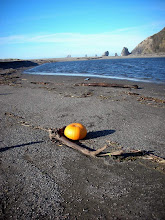
Borrowing from Wikipedia, that eminent source of all things believed by someone else to be true, “vernacular architecture” is the term used to identify structures built from “immediately available resources to address immediate needs.” The definition goes on to describe such structures as usually “crude and unrefined”. No where does the term more rightly find its fruit than on north coast beaches where countless driftwood structures organically materialize from the sand, crafted by unseen hands in a moment’s inspiration, for very temporary occupancy or simple personal fancy.
I’d like to introduce what I hope becomes an occasional series highlighting a distinct architectural style found on this one stretch of beach and others where a steady supply of movable driftwood is available, a style I’ve coined Driftwood Vernacular.[1]
On our little beach, we often discover outstanding examples of driftwood vernacular architecture. The beach here is liberally strewn with driftwood rafted down untold miles of north coast creeks and rivers, smoothed and polished by the sands and salts of the roiling Pacific, and tossed willy-nilly across the silvery Humboldt sands. These smoothed sections of redwood, fir, madrone, oak, alder, and hemlock are the life-sized Lincoln Logs for countless structures that rise and fall with the seasons and the tides.
Driftwood structures, it is presumed, are most often thrown up quickly by regular folks like you and me, but by those with more limited attention spans. While others in their beachcombing party are content to watch the waves, scan for shorebirds, gawk at the seals, or hunt for the perfect stone, these creative constructionists, untrained in the architectural arts, see utility in the storm-tossed beach litter. Fitting peg to hole and beam to post, or crafting tipi tripods without the benefit of rawhide lashes from fresh bison sinew, their creations rise from the sand in mere moments. Then the builders, like the Anasazi of yore, vanish.[2]
Their structures remain behind…for a while at least. Occasionally, they’re reinforced, added to, or altered by the next set of beach walkers. School kids who begin their seasonal migrations to the parks in early March are regular contributors to the driftwood vernacular portfolio. College spring breakers who migrate for shorter periods but at similar times to local school kids, are also suspected participants in the local driftwood arts.
Tides and time take their toll. The harshness of winter’s storms bear no mercy upon these structures. Older buildings are cannibalized by more recent builders who believe they can improve upon the last craftsman’s efforts. And it’s sad but true that now and then, some mindless bureaucrat hoping only for the faint praise of a governmental safety commendation, or perhaps believing that wild beaches must remain free of man’s handiworks, will dismantle and tear asunder the creative genius of those who came before them.[3]
I hope to create among both of the readers of this blog, an appreciation and understanding of Humboldt County’s unique driftwood vernacular landscape. Through documenting their appearance and disappearance here, we can raise the public’s awareness of this important element of coastal heritage of the ultra-near past and present (though if we find something interesting, we may delve into the deeper past as well.)
___
The photos above are of the most current structure on the beach. A small abode, designed for one occupant or a very familiar pair, it is only a few feet across, with a small entry portal. It lacks a roof, as do many of our driftwood vernacular pieces. It does, however, contain the rare example of driftwood furniture: a small seat in the southwest corner of the one-room dwelling. This structure also contains a clue to the builder’s intentions in the charcoal-etched “House” sign, vertically planted at the entryway.
Built on the eastern slope of the high-arching beach, away from the blunt force of the ocean winds, one can imagine the rolling sounds of the surf lulling the occupant into a brief afternoon doze, or perhaps a zen-like meditative state from which the occupant could consider their place in the universe in relative comfort and safety. With the open roof and open door design and a good pair of binoculars, birdwatching opportunities abound in the nearby estuary. Privacy is also assured as most casual beach denizens would steer to the ocean’s side of the beach, leaving this modest structure generally undisturbed.
___
Outside contributors to this article are welcomed. Email or post a link in the comments if you care to share your driftwood vernacular experiences with the masses.
[1] I just invented that term, so any future use of the phrase driftwood vernacular must henceforth be attributed to me. I know, because I Googled it and nothing came up. Like Wikipedia, I’m free to make stuff up as long as it sounds sort of intelligent and no one tries to discredit me.
[2] Yes, I know the Anasazi did not vanish into thin air but dispersed across the southwest and are the forebears of today’s Pueblo peoples, but the phrase above makes for a more interesting literary statement. Literal truth must step aside occasionally for self-described clever turns of phrase.
[3] This is not me.